A Neon Film Cuts Superconducting-Qubit Energy Loss, While a Separate Method Senses Hidden Qubit Noise
A preprint reports that a solid neon film cuts energy loss in superconducting qubits, while a separate Weizmann Institute preprint describes a method for detecting hidden qubit noise without disturbing the qubit.
- Published
- Updated
- 2 min read
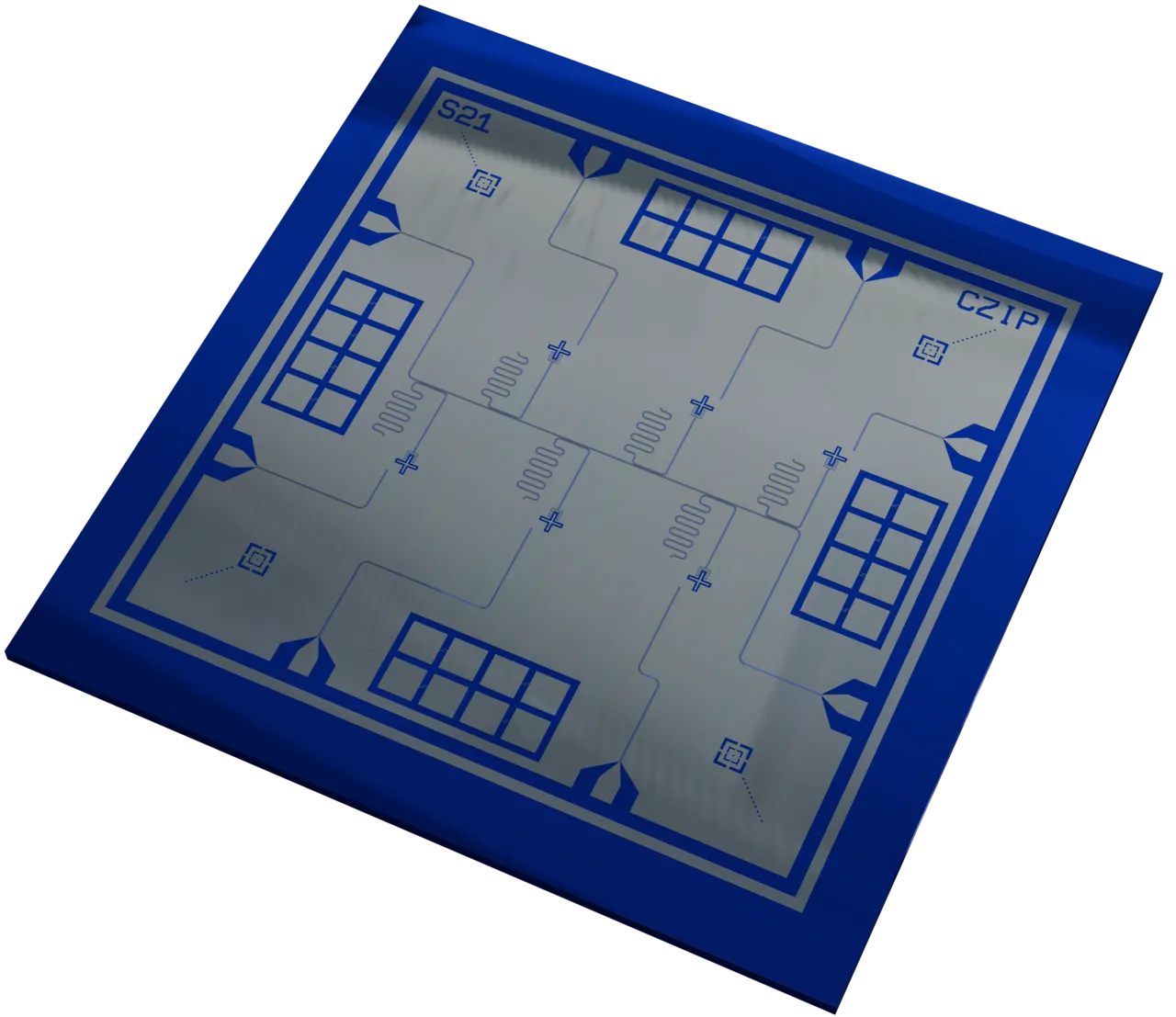
A thin film of solid neon cuts one of the main causes of qubit energy loss, according to the preprint authors, physicist Palmer and colleagues. The film is deposited onto superconducting circuits and then evaporated away. The loss comes from two-level systems, microscopic defects that trap microwave energy and shorten how long a qubit holds its state. Palmer’s team measured the average internal quality factor of superconducting resonators before and after the treatment. It improved by about 4.3 times on one device and about 2.4 times on another. At higher microwave powers, the gain grew to more than an order of magnitude.
The preprint authors tested two niobium titanium nitride coplanar-waveguide resonators. One carried a 40-nanometre neon film on high-resistivity silicon, the other a 12-nanometre film on sapphire. Depositing and then evaporating the neon redistributes surface contaminants that otherwise feed two-level-system losses, the authors say. That makes it a non-destructive alternative to cleaning methods that can damage sensitive superconducting materials.
The quality-factor gains, the preprint authors report, did not disappear once the neon film was gone. They held up after the sample went through a full thermal cycle. The team saw similar behaviour across resonator samples measured in different dilution refrigerators. The size of the improvement still varied with each sample’s surface characteristics.
A second, unrelated preprint tackles a different obstacle for superconducting qubits, the researchers say: catching the noise a qubit generates without disturbing the qubit to measure it. Nitzan Kahn and colleagues at the Weizmann Institute of Science report an upper bound on that noise. The bound is about 0.70×10^3 rad²/s on the intrinsic frequency-noise power spectral density of a superconducting qubit, measured at a qubit-cavity detuning of 508 megahertz. Instead of probing the qubit itself, the team infers the noise from the photon loss it induces in a coupled superconducting cavity.
The researchers validated the technique by injecting artificial noise into the system. The measured photon loss scaled in proportion to the noise they added. They argue the method reaches a higher-frequency spectral window than standard qubit-based spectroscopy. It could characterise noise while a quantum computation is actually running, though statistical limits still constrain its sensitivity at lower noise powers.
Neither paper has yet been through peer review. Both papers’ authors still need to clear the same two hurdles: journal submission and independent replication by other labs.
Sources
MethodologyHow this article was made
- Facts confirmed
- 5 / 5
- Sources
- 2
- Last checked
- Nov 15, 2026
- Image
- Photo
This article was written by an AI system from facts in international trade media, publications by companies and research institutes and public sources, with the source for every fact, and checked under our methodology. The byline is an editorial pseudonym. Found an error? Report it through the contact page.
Facts used
- A new arXiv preprint by A. Palmer and colleagues (Reducing TLS Losses in Superconducting Circuits Using Solid Neon) shows that depositing and then removing a thin solid neon film on superconducting resonators cuts the energy loss caused by so-called two-level systems; the average internal quality factor improved by about 4.3 times on one device and about 2.4 times on another, with the gain exceeding an order of magnitude at higher microwave powers. Palmer et al., Reducing TLS Losses in Superconducting Circuits Using Solid Neon, arXiv:2611.15021 (2026) · Nov 15, 2026
- The preprint tested two niobium titanium nitride coplanar-waveguide resonator devices, one with a 40-nanometre film on a high-resistivity silicon substrate and one with a 12-nanometre film on sapphire, and found that the neon film redistributes surface contaminants before it is evaporated away, acting as a non-destructive alternative to conventional cleaning methods that can damage sensitive materials. Palmer et al., Reducing TLS Losses in Superconducting Circuits Using Solid Neon, arXiv:2611.15021 (2026) · Nov 15, 2026
- The preprint reports that the quality-factor gains persisted even after the neon film had evaporated and the sample was thermally cycled, and that the team observed similar behaviour across resonator samples measured in different dilution-refrigerator setups, though the size of the improvement varied with each sample's surface characteristics. Palmer et al., Reducing TLS Losses in Superconducting Circuits Using Solid Neon, arXiv:2611.15021 (2026) · Nov 15, 2026
- In a separate, unrelated preprint (Qubit Noise Sensing via Induced Photon Loss in a High-Quality Superconducting Cavity), Nitzan Kahn and colleagues at the Weizmann Institute of Science place an upper bound of about 0.70x10^3 rad^2/s on the intrinsic qubit frequency-noise power spectral density of a superconducting qubit, measured at a qubit-cavity detuning of 508 MHz, by detecting the photon loss that this noise induces in a coupled superconducting cavity rather than probing the qubit directly. Kahn et al., Qubit Noise Sensing via Induced Photon Loss in a High-Quality Superconducting Cavity, arXiv:2603.06848 (2026) · Nov 15, 2026
- The preprint says the Weizmann team validated the technique using injected noise, confirming the measured photon loss scales proportionally with the injected noise strength, and argues the method gives access to a higher-frequency spectral window than standard qubit-based spectroscopy and may enable noise characterisation during strong driving, i.e. while a quantum computation is running; statistical limits still constrain sensitivity at lower noise powers. Kahn et al., Qubit Noise Sensing via Induced Photon Loss in a High-Quality Superconducting Cavity, arXiv:2603.06848 (2026) · Nov 15, 2026