Two Japanese-Led Teams Push Quantum Sensing Into Crystals
A University of Tokyo and Northwestern team built a porous crystal forming spin-polarized radical pairs sensitive to surrounding chemistry. A University of Osaka team tracked a single phonon through a ten-ion crystal, a setup it says could scale toward multi-particle simulation.
- Published
- Updated
- 3 min read

A team led by Nobuhiro Yanai at the University of Tokyo and Michael R. Wasielewski at Northwestern University built a porous metal-organic framework, or MOF, according to Nature Communications. Kyushu University collaborators joined the work. The crystal packs a light-absorbing donor molecule and an acceptor molecule into dense, well-defined pairs. That packing selectively produces strongly coupled, spin-polarized triplet radical pairs: pairs of unpaired electrons whose spin states come out aligned rather than random. A metal-organic framework is a crystal built from metal clusters linked by organic molecules into a regular, porous lattice. That structure fixes the donor and acceptor in a repeating arrangement, rather than letting them tumble freely in solution.
According to Nature Communications, the dense packing efficiently quenches the porphyrin’s light-excited state and funnels it into those triplet radical pairs. The pairs show narrow electron paramagnetic resonance signals and long spin-lattice relaxation times. Those relaxation times persist across different guest molecules held in the crystal’s pores, but they also vary with which guest is present. That guest-dependence is what turns the effect from a laboratory curiosity into a sensing mechanism: the radical pair’s spin state reports on the chemistry around it. It extends a phenomenon previously studied in isolated molecules to a structurally organized material. The result is not yet a working sensor. It establishes that the chemical sensitivity survives inside a solid, porous crystal, which is the condition a deployable device would need. The paper on sublevel-selective electron spin hyperpolarization of triplet radical pairs in metal-organic frameworks appeared in Nature Communications on 13 November 2026.
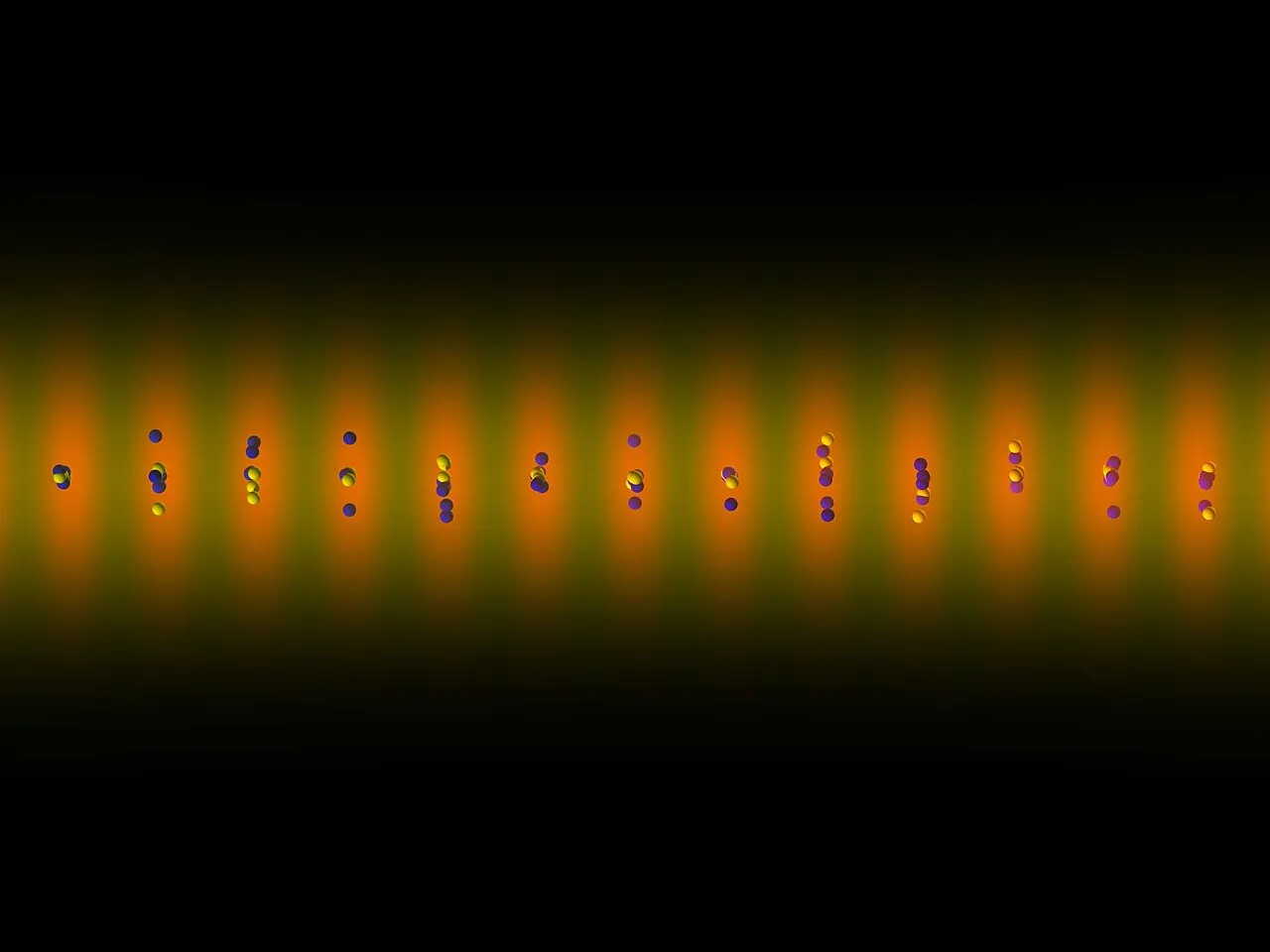
According to the arXiv preprint, a separate, unrelated team at the University of Osaka worked with a different kind of crystal entirely. Takumi Yuri, Yu-Xuan Chen and Kenji Toyoda built a one-dimensional chain of ten trapped calcium-40 ions, held in a harmonic trap that spaces them unevenly, wider at the edges and tighter near the centre. Using laser pulses, the team created a single local phonon, a discrete quantum of vibrational energy, and tracked it as it moved through the chain. The team describes this as one of the largest-scale demonstrations to date of single-quantum control over trapped-ion vibrations.
The arXiv preprint reports that the phonon spread through the chain partly by hopping between neighbouring ions and partly through broader collective motion. The hopping rate between adjacent ions scales approximately as the inverse cube of the distance between them. That measured scaling matched the team’s numerical simulations down to fine detail. It also showed the phonon’s movement is highly sensitive to small changes in ion spacing. The arXiv preprint argues the setup could extend to many-body systems of bosonic particles and more complex quasiparticles. It discusses the Jaynes-Cummings-Hubbard model, which couples each ion’s internal state to its local vibrational mode, as a system the platform could help simulate. The arXiv preprint on quantum propagation of a vibrational excitation in a harmonically confined trapped-ion crystal was posted on 10 November 2026 and has not yet been peer-reviewed.
Sources
MethodologyHow this article was made
- Facts confirmed
- 7 / 7
- Sources
- 2
- Last checked
- Nov 13, 2026
- Image
- Photo
This article was written by an AI system from facts in international trade media, publications by companies and research institutes and public sources, with the source for every fact, and checked under our methodology. The byline is an editorial pseudonym. Found an error? Report it through the contact page.
Facts used
- An international team of Tomoyuki Hamachi, Nobuhiro Yanai (University of Tokyo), Michael R. Wasielewski (Northwestern University) and collaborators at Kyushu University built a metal-organic framework (MOF) that places a naphthalenetetracarboxdiimide acceptor and a zinc-porphyrin donor in dense, locally well-defined donor-acceptor arrangements inside the porous crystal, which selectively forms strongly coupled, spin-polarized triplet radical pairs. Nature Communications · Nov 13, 2026
- The dense donor-acceptor packing promotes efficient quenching of the porphyrin's singlet excited state and selectively forms the strongly coupled triplet radical pairs, which show narrow electron paramagnetic resonance signals and long spin-lattice relaxation times that persist across different guest solvents and vary with guest identity, extending spin dynamics from isolated molecules to a structurally organized material. Nature Communications · Nov 13, 2026
- The work is published in Nature Communications on November 13, 2026, under the title "Sublevel-selective electron spin hyperpolarization of triplet radical pairs in metal-organic frameworks" (DOI 10.1038/s41467-026-79262-6). Nature Communications · Nov 13, 2026
- A University of Osaka team of Takumi Yuri, Yu-Xuan Chen and Kenji Toyoda built a harmonically confined, one-dimensional crystal of ten trapped calcium-40 ions with uneven spacing, wider at the edges and tighter near the centre, and used laser pulses to create and track a single local phonon (a quantum of vibrational energy) moving through the chain, which the team describes as one of the largest-scale demonstrations of single-quantum control of trapped-ion vibrational states to date. arXiv preprint · Nov 13, 2026
- Vibrational energy moved through the ion crystal partly through hopping between neighbouring ions and partly through broader collective motion; the measured phonon hopping rate between adjacent ions scales approximately as the inverse cube of the inter-ion distance, matched the team's numerical simulations down to fine details, and showed that phonon movement is highly sensitive to small changes in ion spacing. arXiv preprint · Nov 13, 2026
- The preprint says the system explored could extend to many-body systems of bosonic particles and more complex quasiparticles, and discusses the Jaynes-Cummings-Hubbard model, which combines internal states and local vibrational modes in trapped ions, as a physical model the platform could help simulate; Quantum Zeitgeist connects this scalability to quantum sensing approaches that exploit how sensitive phonons are to their environment. arXiv preprint · Nov 13, 2026
- The paper, titled "Quantum propagation of a vibrational excitation in a harmonically confined trapped-ion crystal," was posted to arXiv on November 10, 2026 (arXiv:2611.13967v1). arXiv preprint · Nov 13, 2026