Extra Measurement Step Cuts Superconducting Qubit Error Rate by 77 Percent
A seven-institution team found that adding one measurement before a run of quantum operations lets a superconducting qubit's control signals track its shifting resonance frequency, cutting its average gate error by about 77 percent.
- Published
- Updated
- 2 min read
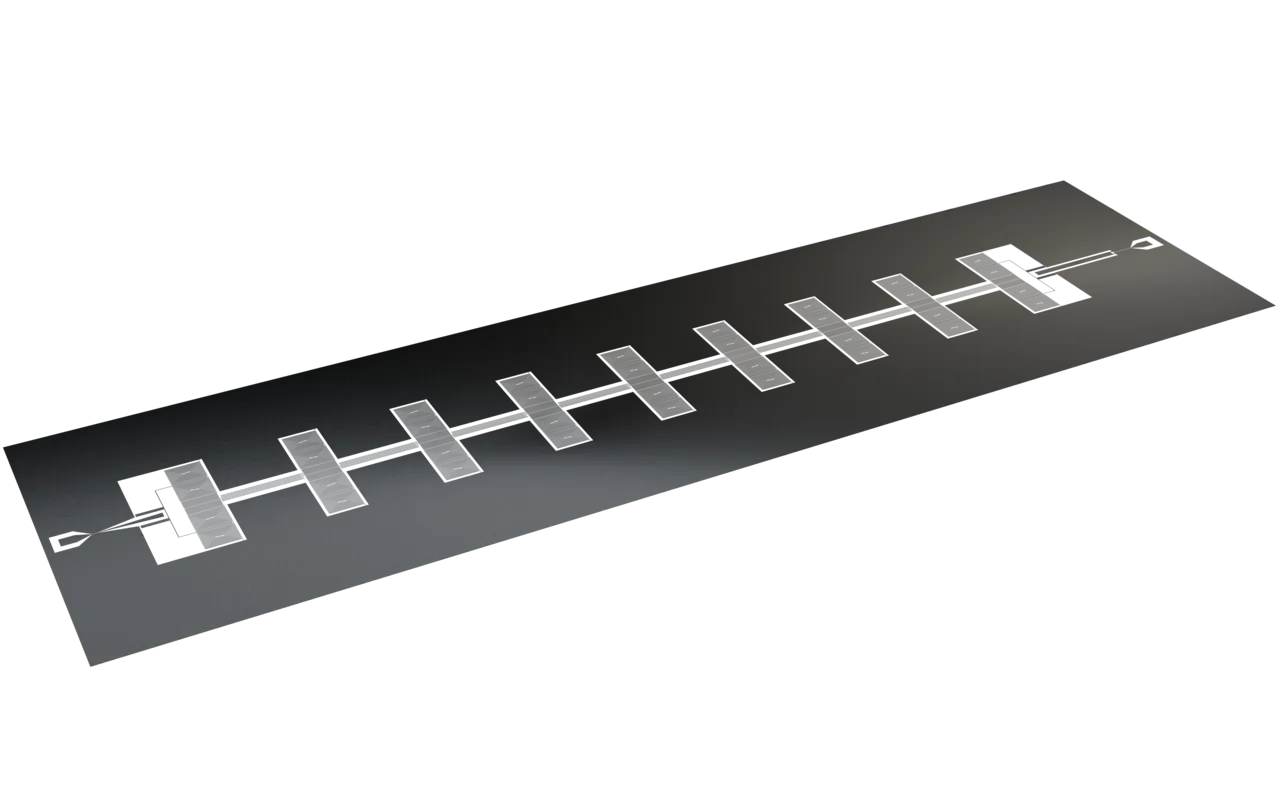
Researchers have cut a superconducting qubit’s error rate by about 77 percent, according to the published study, simply by measuring it once more before putting it to work. Randomized benchmarking showed the qubit’s average gate infidelity fall from (1.4±1.1)×10⁻³ without the extra step to (0.65±0.18)×10⁻³ with it.
The qubit involved is bistable, according to the published study. It is a transmon, the most common type of superconducting qubit. Rather than sitting on one resonance frequency, it randomly flips between two. That drift matters, because control pulses must be tuned to the qubit’s resonance frequency. When the qubit jumps to its other state mid-sequence, those pulses miss their target and errors creep in.
A seven-author team addressed that by inserting a single measurement right before a run of quantum operations. The team spans the University of Regensburg, MIT, the University of Copenhagen, Leiden University, the Norwegian University of Science and Technology, and the companies QM Technologies and Qolab. The extra measurement tells the control system which of the two frequencies the qubit currently occupies. The system then adjusts its control signals in real time to match, instead of tuning them for an average that fits neither state well. The qubit itself was operated at the Israeli Quantum Computing Center.
The near fourfold cut in infidelity is notable because it comes from a timing and control trick, not a change to the chip’s hardware or materials. Lower gate error rates matter for scaling up. Schemes such as the surface code scale their overhead directly with how reliable the underlying physical qubits already are, so fewer errors mean fewer extra qubits spent on correction.
The work, according to the published study, was led by Fabrizio Berritta, with Ferdinand Kuemmeth among the senior co-authors. It appears as Operating a bistable qubit in Applied Physics Reviews, volume 13, issue 4.
Sources
MethodologyHow this article was made
- Facts confirmed
- 3 / 3
- Sources
- 2
- Last checked
- Nov 3, 2026
- Image
- Photo
This article was written by an AI system from facts in international trade media, publications by companies and research institutes and public sources, with the source for every fact, and checked under our methodology. The byline is an editorial pseudonym. Found an error? Report it through the contact page.
Facts used
- With the extra measurement and real-time feedback in place, randomized benchmarking showed the qubit's average native-gate infidelity (error rate) fall from (1.4±1.1)×10⁻³ without feedback to (0.65±0.18)×10⁻³ with feedback, a reduction of about 77 percent. Applied Physics Reviews (AIP Publishing), the paper itself · Nov 3, 2026
- A seven-author team spanning the University of Regensburg, MIT, the University of Copenhagen, Leiden University, the Norwegian University of Science and Technology and the companies QM Technologies and Qolab found that adding a single measurement before a series of quantum operations lets them identify which of two resonance frequencies a superconducting (transmon) qubit is currently using, so control signals can then be adjusted in real time to match it. The qubit they studied, run at the Israeli Quantum Computing Center, is described as "bistable," meaning it can randomly switch between two different operating states. Applied Physics Reviews (AIP Publishing), the paper itself · Nov 3, 2026
- The work is described in a paper titled "Operating a bistable qubit," with Fabrizio Berritta as lead author and Ferdinand Kuemmeth among the senior co-authors (alongside Jan A. Krzywda, Tom Dvir, Paul Buttles, Stanislav Eilhart and Jeroen Danon), published in the journal Applied Physics Reviews, volume 13, issue 4 (DOI 10.1063/5.0340790). Applied Physics Reviews (AIP Publishing), the paper itself · Nov 3, 2026